March 2019
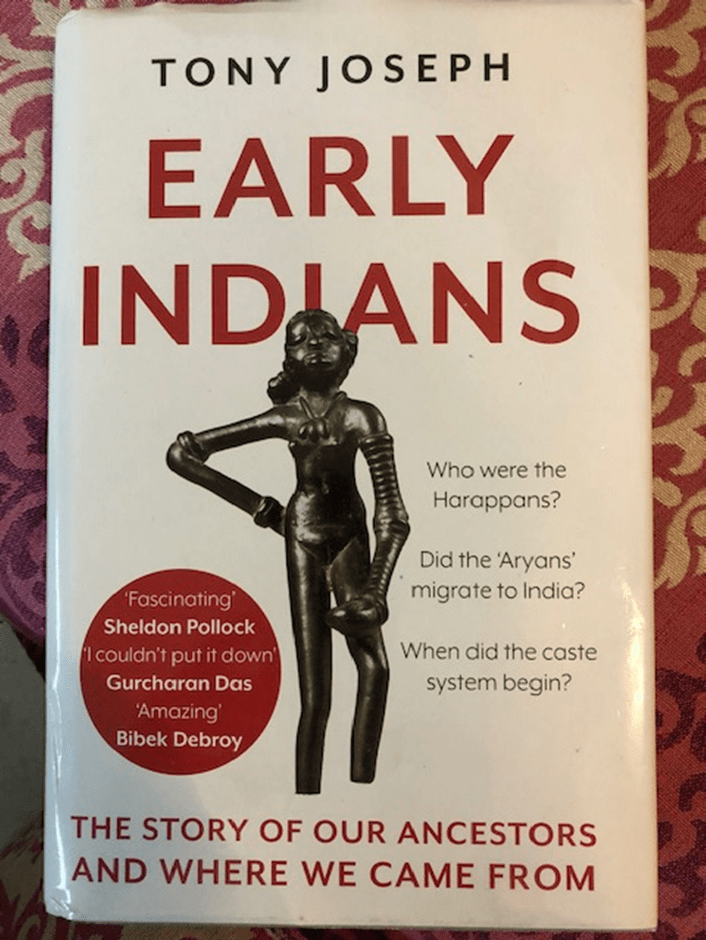
This piece is an adulatory piece on the book, “Early Indians”, written by Tony Joseph in late 2018. It is not so much a review than the summary or highlights of key points. I strongly recommend going through the long version (which is only 200 pages long, big font) to really enjoy the pre-history of India, and hope the below vets your appetite to do so.
I am aware that Tony’s book is leading to one particular conclusion of Aryans having come to India along with Sanskrit and modern Hinduism in tow. Hence, it is open to attack from a set of people who would like to believe that our current religion is ancient and indigenous. However, I don’t have the wherewithal to agree or disagree with any one view-point. I am a simple reader of “Early Indians” and am reproducing some of the highlights here J.
For Indian readers (and Indophiles), “Early Indians” picks up from where Harari’s Sapiens left off.
UNDERSTANDING THE SCIENCES behind unravelling the Mystery of History :
Various fossils – skeletons / bones etc have been discovered over the past 100 years by archaeologists, along with vessels, art, pots etc. Carbon-dating technology helped us guess how old each fossil / object was. Our understanding of pre-history (before it was written with names of some people, and before it became History) has been primarily from analysing these finds, essentially through the fields of archaeology and anthropology.
But now, post 2010, something wonderful has happened – Population Genetics and Ancient DNA!! Genetic scientists have acquired an ability to extract DNA from these ancient fossils and then depending on the age of the fossil (carbon-dated), we have started putting together the origins of these people. Marrying the anthropological evidence from objects, we are putting together what would have been their life-styles too.
In March 2018, a seminal study was conducted by 92 scientists from around the world, titled “The Genomic Formation of South and Central Asia” – the group comprised scientists from different fields, along with 6-7 leading scientists from India too. They studied ancient DNA of 612 individuals and quite a bit of our new knowledge of Indian pre-history is based from this paper.
The next science super-imposed on the archaeology, anthropology and (ancient) genetics is epigraphy (study of scripts) and linguistics or more appropriately philology (study of history and evolution of languages). These helped in validating the other findings, deciphering from scripts on walls and seals discovered during the same times.
The above sciences are being applied to understand the pre-history of various regions of the world, and students entering school from the 2020s across the world will be much smarter in understanding our origins.
On the above Genetic analysis is finally superimposed the Climatic analysis – Earth has been going through alternating phases of cold/glacial climate and warm/wet climate, each phase lasting 15000-50000 years. We are currently in a wet/warm phase which started 12,000 years ago, called Holocene. The period of 15,000 years before that was an Ice Age. The 28,000 years before that ice age (55000 to 27000 years ago) was a wet/warm age when majority of the migration of African Homo Sapiens occurred.
Tony Joseph (ex-Editor of Business World) has delved deep into the ancient DNA studies of the recent past and married it with secondary research on earlier sciences to present to us EARLY INDIANS, a deep dive into possible origins of people of the Indian sub-continent.
CHRONOLOGY OF KEY EVENTS :
“Early Indians” broadly describes the following key milestones or events happening across time :
- Till 65,000 years ago, Homo Sapiens were localised only in the African continent. The first Out of Africa (OoA) migration started in this period, and a bunch of Homo Sapiens reached India too – the author calls them the First Indians. Since Man is 300,000 years old across the world, the First Indians met archaic humans (some other Homo genus) already staying in India. Gradually, the First Indians prevailed, thanks to their use of Micro-lithic technology (small stones used in arrows and spears) as opposed to rough instruments being used by older species (Palaeolithic). If you have read Yuval Harari’s Sapiens, this coincides with the Cognitive Revolution mentioned in his book.
- 45000-20000 years ago, South Asia had already become the most densely populated regions in the world
- 7000 BCE : Agricultural settlements started in modern-day Afghanistan, Pakistan, Punjab; also in Ganga valley and Gujarat (this coincides with the world-wide Agricultural Revolution of around 12000-7000 BCE mentioned in “Sapiens”)
- 7000-3000 BCE : A bunch of agriculturists from the Zagrosian region of Iran migrate to North-West India, and mix with First Indians in that region (this was concluded from genetic analysis of fossils found from that period, and then analysing current genes of people across the world to conclude that “hey it was indeed people from the Zagrosian region who had migrated and mixed here”). As also from similar ways of building bricks, pots etc.
- 2600-1900 BCE – the golden era of the Harappan URBAN civilisation; when various planned cities in this region (modern-day Pakistan, Punjab, Afghanistan, Rajasthan) were developed. This came about as agriculture started throwing out surpluses, thereby giving people luxury to channel their time and effort to different skills – building walls, monuments for new cities, pottery, blacksmith for tools and weapons, jewellery, art, construction, and in general new inventions. There was an elite group (there didn’t seem to be a monarchy) who would take the agricultural surpluses (taxes) and channel to other fields. At its peak, this Civilisation covered 1mn sq km covering much of modern-day Pakistan, NE Afghanistan, Punjab, Rajasthan, UP and Gujarat. Larger than the Mesopotamian and Egyptian civilisations, combined. This Civilisation was known elsewhere by the name Meluhha, as found in Mesopotamian records (yes, Amish has researched well too 😊).
- After 2000 BCE, a long drought lasting a few hundred years destroyed the Harappan civilisation and people migrated to inner parts of India (the drought affected China, Egypt too). The drought may have been triggered by shifts in ocean and atmospheric circulation.
- 2000-1000 BCE – coincidentally along with the end of the Harappan civilisation (or Indus Valley civilisation), a huge wave of migration of pastoralists from the Steppe regions (modern-day south Russia, Ukraine, West tip of Kazakhstan) happened over 1000 years. These people also migrated around 3000 BCE to various parts of Europe; hence, all of Europe and parts of Indian sub-continent speak Indo-European languages brought by these pastoralists; in India, these were Sanskrit, Hindi, Punjabi, Marathi, Gujarati, Bengali.
SOME INTERESTING FACTS – till 7000 BCE :
- If one has the mitochondrial DNA or matri-lineal DNA (mtDNA) and Y-chromosome of a person, it is possible to trace back the person’s maternal and paternal lineage over time; since global human genetic database exists for Y-chromosome and mtDNA, it is now possible to locate where in the world people who belong to same group are widely present. MtDNA is transferred from mother to daughter in an unbroken chain and Y-chromosome is transferred from father to son.
- Climatic phases – the last 2.6 million years can be divided into 104 ALTERNATING climatic phases called Marine Isotopic Stages (MIS), based on analysis of Oxygen Isotope level found in deep sea drilling. 2.6mn divided by 104 is roughly 23,000 years and hence each phase is 15000-50000 years long, as mentioned in the Intro passage above.
- Modern-day humans (Sapiens) started emerging in Africa around 300,000 years ago and began their foray into Levant region (Syria, Israel, Lebanon, Jordan) about 180,000 years ago and into Arabia 88,000 years ago
- OoA migrants reaching India about 65,000 years ago quickly reached South Asia and even Australia over the next 5-10,000 years; Europe was populated by the OoA people 45000 years ago
- About 16000 years ago, when glacial period was ending, modern man made his way from Asia to Americas through the land bridge between Alaska and Russia
- In Europe, Americas or Australia, modern-day people have weak linkages to the DNA of the First OoA migrants to these regions – because of huge waves of migration post that. However, in India, 50-65% of modern-day Indians have a trace of DNA of First Indians – a very large number. In fact, 70-90% of Indian women have mtDNA traced back to First Indians, while 10-40% of Indian men have Y-chromosome traced back to First Indians (the disparity between men and women arises from the fact that many waves of migration, especially the Aryans in 2000-1000 BCE were predominantly males).
- Further, this First Indian ancestry has no close relative outside the Indian sub-continent today; looks like south-east Asia, Far East, Australia separation happened 65,000 years ago, and there was not much mixing post that with First Indians.
- The first post-cognitive-revolution wave of migration outside Africa 60000-70000 years ago was of hunter-gatherers moving out to explore new areas with more food; the second wave of migration 5000-10000 years ago was after agricultural revolution exploded population and people had to move to newer areas to settle down.
SOME INTERESTING FACTS – 7000BC-2000BC in India :
- The weapons that the Harappans had in their 700 years of the Harappan Civilisation were spears, knives and arrows, good for hunting animals but not for winning wars – in these 700 years, there is no evidence of any of the cities getting attacked or burnt down.
- Harappan cities had well-planned layouts, good water management systems, toilets (with lotas)
- Dholavira town in Rann of Kutch was a Harappan city – the white salt stretches were under water that time, and this was a port for trade
- The next wave of urban civilisation after Harappan decline in 1900 BCE was around 300-400 BCE when kings of the Mauryan empire built cities
- We have been unable to decipher the script found on seals of Harappan civilisation; the Egyptian civilisation script was accidentally cracked only after the Rosetta stone of 196 BCE was discovered in 1799, with the same inscription in three scripts, making it easy to cross-compare them and crack the code of the script itself. We wait for our Rosetta stone equivalent.
- However, from ancient DNA analysis (not script analysis), we have concluded that people in Harappan civilisation spoke Dravidian languages (similar to modern-day Tamil, Malyalam, Kannada, Telugu) and as people migrated post the Great Drought to inner parts of India, these languages moved to other parts of Indian too, predominantly the south and central parts. Looks like the Northern and Eastern parts had their own civilisations and hence, the Harappans moved to the other parts more. The Zagrosian language, Elamite shows many similar words to Tamil.
- Further, later on, the Aryans (Steppe Pastoralists) moved and settled down more in north and east India, thereby limiting the extent of the Harappan languages there. While the Harappan languages slowly moved southwards, the culture and myths of the Harappan people merged with those of the Aryans to produce a unique Indian culture. Therefore, there is a disconnect between earliest Vedas and practices of Harappan civilisation; but later Vedic work and Harappan civilisation have common ground, showing acceptance from both sides to borrow ideas and practices from each other, gradually.
SOME INTERESTING FACTS – 2000BC onwards in India :
- About 75% of Indians today speak an Indo-European language – Hindi, Punjabi, Marathi, Gujarati, Bengali; 40% of the non-India world also speaks Indo-European languages – Spanish, English, French, German, Russian, Iranian, Portuguese. The Indian sub-continent forms the eastern limit for spread of Indo-European languages.
- R1a-M417 haplo-group of Y-chromosome is seen across Scandinavia to south Asia, covering almost entire Indo-European language speaking world; this haplo-group split around 3800 BCE into 2 sub-groups – R1a-Z93 is seen in parts of central Asia and South Asia, and accounts for almost all the R1a lineages in India. Its brother, R1a-Z282 is spread all over Europe. R1a-Z93 was found in many samples of Asian Steppe regions dating 2500 BCE. It is present in modern-day Kazakhstan too!!!
- Now…if you look at the presence of R1a among current Indian population, esp in Brahmins, we find there is much higher prevalence of this group; it’s twice as prevalent than among SCs and STs. Brahmins were the traditional custodians of Sanskrit.
- The Steppe Aryan migrants (called Yamnaya) mixed with Harappans in North India (in turn First Indians + Zagrosians) creating the Ancient North Indian gene; the Ancestral South Indian gene was formed by mixing of Harappans with First Indians. All of us today are descendants of ANI, ASI or a result of mixing of the two.
- Out of 140 modern Indian groups which were analysed for their genes, 10 stood out with disproportionate amounts of Steppe ancestry – top two of these were traditionally of priestly status – Brahmins. Strong rules of endogamy (marrying within one’s own community) in these communities may have resulted in higher amounts of Steppe ancestry retained.
- The Yamnaya had also spread all over western Europe around 3000 BC; they even replaced the Stonehenge people in the UK too
- One difference between experiences of western Europe and south Asia with respect to multiple mass migrations is that in western Europe, each migration significantly replaced the previous population while in south Asia, the migrants mixed in. This was probably because of more number of people in south Asia at any time. This is brought about in languages too – 94% of western Europeans speak Indo-European languages while only 75% Indians do.
- The Aryans arrived with a pastoralist lifestyle, new religious practices such as large sacrificial rituals, a warrior tradition and mastery over horse and metallurgy. That the newly dominant elite had a preference for a non-urban, mobile lifestyle may be part of the reasons why India had to wait for more than 1000 years after the Harappan civilisation for its next civilisation – the Mauryan empire around 500 BCE.
- The main gods of Rigveda – Indra, Agni, Varun, Asvins – were not seen in the seals of the Harappans, who had unicorn and phallic symbols to worship. Rigveda was developed somewhere between 2000 BCE and 1400 BCE. By the time the Upanishads were written between 500BCE and 100BCE, there was quite a bit of mixing between the Aryan and the Harappan cultures – number of borrowed Dravidian words are much more in Upanishads. Yoga, a Harappan culture phenomenon found its way into the Upanishads. Just like the script and seals of the Harappan culture faded away, so did some of the early Gods and rituals of the Vedas. Sanskrit, the language of the Aryans itself assimilated many Dravidian words and constructs.
- The Aryan migrants were the last migrants to have a significant impact on our genetic demography. There have been several incursions since then – Alexander in 326 BCE, Sakas around 150 BCE, Huns around 450 CE, Arabs in 710 CE, Mughals in 1526 CE, and finally, the Portuguese, French, Dutch and British. In between, the Parsis, the Siddhis, the Syrians, the Jews too. They all may have had a cultural influence, but no demographic influence – that is, there was no mass mixing with the indigenous people. Of course, that 18-20% of our population today is non-Hindu is a most significant point; however, even the religious minority today should be exhibiting the same mix of ANI, ASI or the combo genetic structures, and it was a “cosmetic” religion change that happened.
- Indo-Aryan languages could again be divided into two regions – the inner region comprising North-Central India and the outer region comprising the southern-west and the eastern. From language perspective, the inner region comprised Hindi, Punjabi, Rajasthani, Bundeli, Pahari. The outer group would comprise Bangla, Bihari, Marathi, Oriya, Konkani. These regions also correspond to the terms of Aryavarta and the Mlecchha-Desas (Barbarian lands). The Vindhyas divided the two regions. The inner groups were highly orthodox and genetically mixed less with others.
- The Mauryan empire was formed in the non-Aryavarta region in 500 BCE, and the two religions of Jainism and Buddhism took roots there, challenging the orthodoxy of the Brahminical culture of the Aryans.
- Manusmirti written between 200 and 300 CE mentioned Aryavarta as extending from sea to sea; possibly the success of the Mauryan empire and that of Buddha and Mahavir Jain forced the widening of the definition.
- The mixing of genes which started from 7000 BCE stopped around 100 CE, almost as if a new ideology had gained root and imposed a new way of life on society. It was social engineering on a large scale and highly successful. This was the beginning of the Caste system.
- The period from 500BCE to 100 CE was one of the most creative and progressive periods in the history of India, with the advent of the Upanishads, Jainism, Buddhism, spread of Indian ideas into east Asia and even into China. However, for some reason, the restrictive practices of Aryavarta – namely caste system, endogamy and no voyages across the oceans finally won the battle and continues to even today.
- The Han Chinese are truly a large homogenous population with similar genetic build-up. Because of the endogamic nature of Indians for the past 2000 years, the genetic differences between people in two neighbouring villages is as much as those between southern and northern Europeans. India is composed of a large number of small populations. This may also explain the lack of fellow feeling among even people living in the same locality.
- Today, Indians in north and west India can digest milk well into their adulthood; while those in south and east India can’t. This is because of some gene mutation that has happened over the past thousands of years. The point is over the last 2000 years, there are varied sub-cultures in India now, though rooted primarily in the ANI, ASI and hence First Indians, Harappan, Aryan gene pool. Hence, doing anything funny like imposing Hindi on entire country or trying to homogenise the nation along any lines – of caste, race, language, religion will be quite a silly thing to do.
- So finally, we are a multi-source civilisation, drawing our cultural impulses, traditions, practices from a variety of heredities and migration histories. OoA+Zagros+Aryans+8-10 later incursions in the last 2000 years have shaped us as a nation today. We should enjoy this feeling.
I decided to add some value by going through relevant articles on the Internet, some agreeing and some disagreeing with Tony Joseph’s book and views. Have listed the links to these articles below.
 Rational Exuberance